Key Takeaways
- Fat-Soluble vs. Water-Soluble: Vitamins A, D, E, and K, as well as Omega-3s, should always be taken with a meal containing healthy fats for proper absorption. Water-soluble vitamins (B and C) offer more flexibility.
- Empty Stomach Essentials: Probiotics and iron are best absorbed on an empty stomach. However, if iron causes nausea, taking it with a small snack is a good alternative.
- Strategic Timing: Take energizing supplements (like B-complex and Rhodiola) in the morning to support daytime alertness, and relaxing supplements (like magnesium and Ashwagandha) in the evening to wind down.
- Smart Pairings: Some nutrients work better together, such as Vitamin D3 paired with K2, or Iron paired with Vitamin C.
- Consistency is Key: While proper timing optimizes absorption and minimizes stomach upset, taking your supplements consistently every day matters more than perfect timing.
Morning supplements (empty stomach or with breakfast)
Multivitamins
Multivitamins contain a blend of fat‑soluble and water‑soluble nutrients, along with minerals that may cause nausea on an empty stomach. Taking them with food supports absorption and improves tolerance.
Because multivitamins often contain B vitamins, taking them earlier in the day helps avoid any mild energizing effects at night. Pairing them with breakfast or lunch also helps establish a consistent routine, which is key for long‑term supplement success.
- Best time: Morning, with food.
Water-Soluble Vitamins (B-Complex and Vitamin C)
Water-soluble vitamins dissolve easily in water and do not require dietary fat for absorption.
B vitamins play a central role in converting food into energy. A recent review on nutrient timing and metabolic regulation highlighted that B vitamins may support daytime alertness when taken earlier in the day. Taking them at night may interfere with sleep for some people, especially those sensitive to energizing nutrients.
Vitamin C is more flexible. It can be taken with or without food, though taking it with a snack may reduce the chance of mild stomach discomfort in sensitive individuals.
- Best time: Morning, with or without food.
Probiotics
Probiotic survival depends on stomach acidity. Many strains perform better when taken away from meals, allowing more organisms to reach the intestines intact. Reviews of probiotic delivery systems highlight improved survival when taken on an empty stomach, especially with delayed‑release capsules.
- Best time: First thing in the morning on an empty stomach (or right before bed).
Iron
Iron is best absorbed on an empty stomach because food, especially calcium, coffee, tea, and fiber, can interfere with uptake. However, iron is also one of the most nausea‑inducing supplements. Recent clinical trials have shown that morning dosing may support better absorption patterns, and alternate‑day dosing can improve tolerance.
- Best time: Morning, on an empty stomach (avoid pairing with calcium, magnesium, or caffeine).
Energizing Adaptogens
Herbal supplements (e.g., Rhodiola) that support energy, focus, and mental clarity, such as Rhodiola, are best utilized at the start of your day to align with their physiological effects.
With-meal supplements (lunch or dinner)
Vitamin D
Vitamin D is one of the most widely supplemented nutrients, and timing can influence both absorption and how it makes you feel. While vitamin D can technically be taken at any time, pairing it with food improves bioavailability. Many people prefer taking it earlier in the day because vitamin D plays a role in wakefulness and interacts with hormones that follow a daytime rhythm.
Research shows that taking vitamin D with a meal containing healthy fats improves serum levels more effectively than taking it on an empty stomach. This is because fat triggers bile release, which helps transport fat‑soluble nutrients through the intestinal wall.
Some emerging research suggests that taking vitamin D in the morning may align better with natural cortisol patterns, though this is not a strict requirement. What matters most is consistency, paired with a meal that contains fat.
- Best time: Morning or midday, with a meal containing healthy fats.
Fat-Soluble Vitamins (A, E, and K)
Fat-soluble vitamins require dietary fat for absorption. They rely on bile acids and lipids in the digestive tract to be transported into the bloodstream. Without fat, absorption drops significantly. Taking these with food also reduces the risk of nausea.
- Best time: With a meal containing healthy fats (like avocado, nuts, seeds, or olive oil).
Omega-3 Fatty Acids (Fish, Krill, or Algae Oil)
Omega‑3 supplements, including fish oil, krill oil, and algae oil, are better absorbed when taken with dietary fat. Research comparing high‑fat vs. low‑fat meals shows significantly improved uptake of EPA and DHA when omega‑3s are paired with food. Taking them with a meal also reduces the chance of fishy burps.
- Best time: With a robust meal, typically lunch or dinner.
Calcium
Calcium competes with iron and zinc for absorption, so spacing it out is helpful. It absorbs well with food, and taking it with meals reduces the chance of digestive discomfort.
- Best time: With meals, separated from iron supplements.
Fat-Soluble Herbs
Herbal supplements (e.g., Turmeric/Curcumin) are fat-soluble and require the presence of lipids in the gut to maximize their bioavailability.
Evening supplements
Magnesium
Magnesium supports muscle relaxation, nerve function, and sleep quality. Many people find it soothing in the evening, and research exploring magnesium and sleep markers supports this timing. Magnesium glycinate is particularly well‑tolerated and commonly used at night.
- Best time: Evening, with or without food (take with food if you have a sensitive stomach).
Calming Adaptogens
Herbs designed to support relaxation, lower stress levels, and balance the nervous system, such as Ashwagandha, are ideal for winding down at the end of the day.
Flexible timing (any time of day)
- Collagen peptides: consistency matters more than timing. Can be taken with or without food, in a beverage, or blended into food.
- Creatine monohydrate: daily use and total dose matter more than exact timing. Can be taken with or without food.
- L-theanine: flexible timing. Often taken in the morning with caffeine to smooth its stimulating edge, or in the evening to support relaxation. Follow product directions.
- Fiber supplements: any time of day, with plenty of water. Fiber taken without sufficient water may cause bloating or constipation.
- Electrolytes: morning, during exercise, or as needed based on hydration and activity level.
- Elderberry: flexible timing. Follow product directions.
- NAC (N-acetyl cysteine): timing may vary by formulation and intended use. Follow label recommendations.
Quick guide to empty stomach vs. food
If you are ever unsure, follow this basic rule of thumb:
Best taken on an empty stomach:
- Iron
- Probiotics
- Certain amino acids
Best taken with food:
- Multivitamins
- Vitamin D
- Omega-3s
- Fat-soluble vitamins (A, E, K)
- Magnesium (if you have a sensitive stomach)
Note: If you ever experience nausea from a supplement meant for an empty stomach, taking it with a very small snack is usually the easiest solution.
Simple daily timing guide
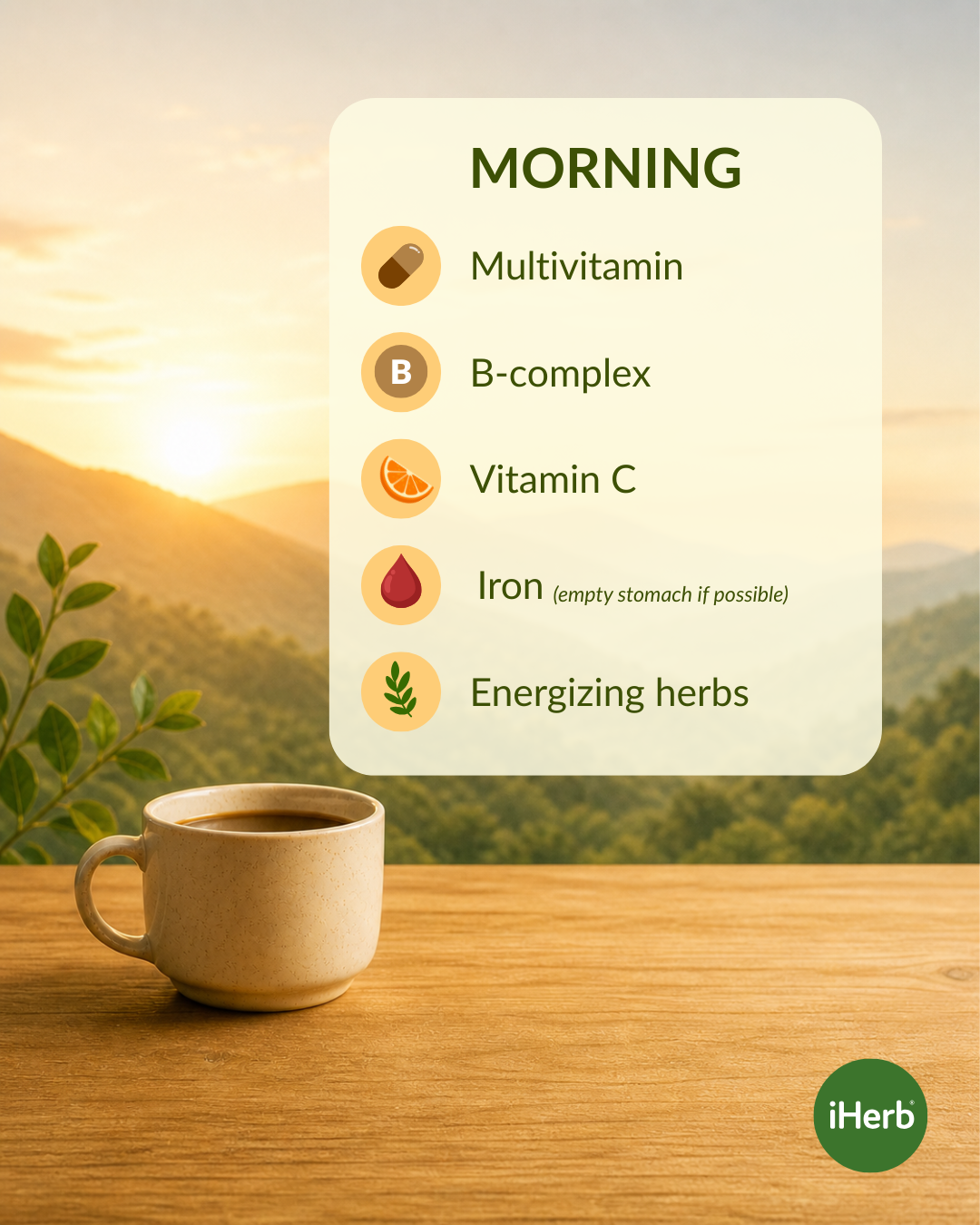
Morning
- Multivitamin
- B‑complex
- Vitamin C
- Iron (empty stomach if possible)
- Energizing herbs
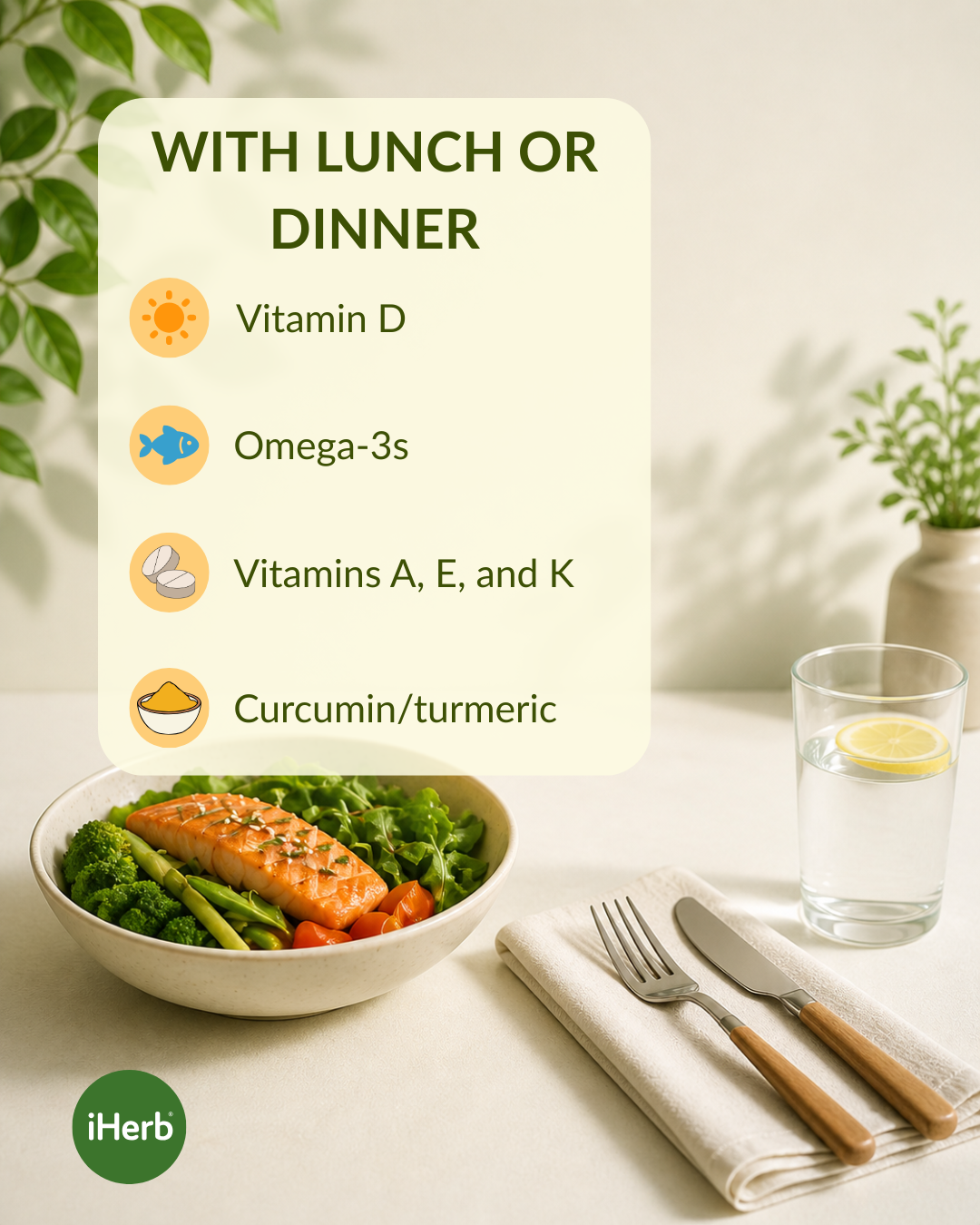
With Lunch or Dinner
- Vitamin D
- Omega‑3s
- Vitamins A, E, and K
- Curcumin/turmeric
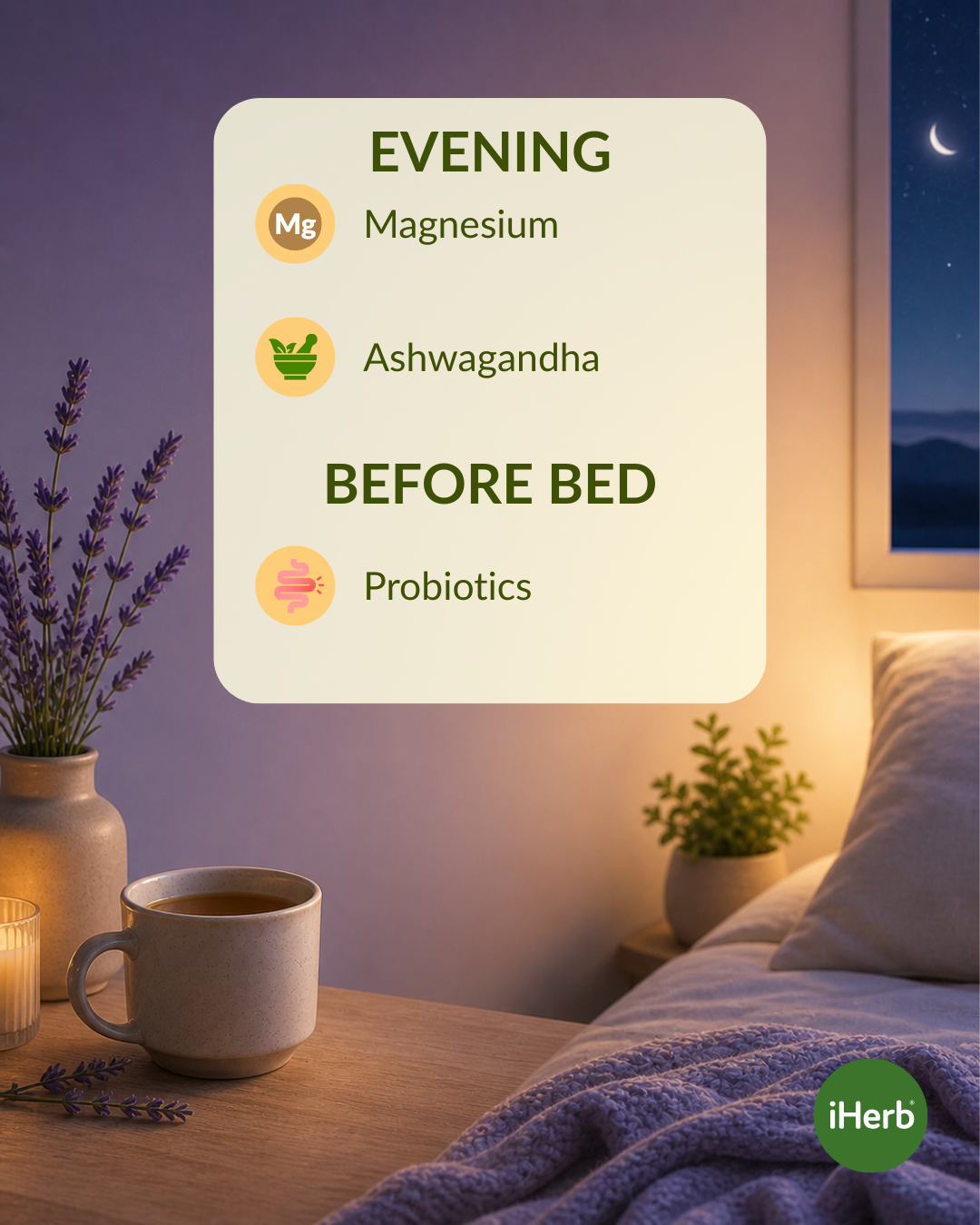
Evening
Before Bed
- Probiotics (empty stomach if possible)
This structure supports energy during the day, relaxation at night, and optimal absorption throughout.
Supplements that work well together
Some nutrients are absorbed more effectively or have complementary biological roles when taken together. The following pairings are commonly used and well-supported:
- Vitamin D3 + Vitamin K2: Both are fat-soluble and are frequently combined in the same formula. Vitamin D3 supports calcium absorption; vitamin K2 (MK-7 form) helps direct calcium to bones and away from arteries. Take together with a fat-containing meal.
- Vitamin D + Magnesium: Magnesium is required as a cofactor for the enzymatic conversion of vitamin D into its active form (calcitriol). Many people who are deficient in vitamin D are also low in magnesium.
- Iron + Vitamin C: Vitamin C (ascorbic acid) converts ferric iron (Fe³⁺) to the more absorbable ferrous form (Fe²⁺), improving non-heme iron absorption by up to 67% in some studies. Many iron supplements already include vitamin C for this reason.
- Calcium + Vitamin D: Vitamin D enhances calcium absorption in the intestine by stimulating the synthesis of calcium-binding proteins. These two are among the most studied nutrient pairings in bone health research.
- Omega-3 + Vitamin D: Both are fat-soluble and taken with meals, making them convenient to pair in the same routine. No known negative interaction.
Supplements to avoid taking together
- Iron + Calcium: Calcium competes with iron at the DMT1 intestinal transporter. Take iron in the morning and calcium with a separate meal.
- Iron + Coffee or tea: Chlorogenic acids in coffee and tannins/polyphenols in tea can reduce non-heme iron absorption by 50–90%. Separate iron from coffee or tea by at least one hour.
- Zinc + High-dose iron: Divalent minerals (Fe²⁺ and Zn²⁺) share intestinal absorption pathways. High-dose supplementation with both simultaneously may reduce absorption of either. Follow product-specific guidance.
- Zinc + Copper: Long-term supplementation with high-dose zinc (above 40 mg/day) can deplete copper by competing at the metallothionein binding site. If supplementing zinc long-term, consider a formula that includes copper or monitor copper status.
Taking supplements during intermittent fasting
Optimal supplement timing depends on the supplement and the goals of the fasting protocol.
Supplements to take during your eating window (require food for absorption or may break a fast): Vitamin A, Vitamin D, Vitamin E, Vitamin K2, Omega-3 fish oil, CoQ10, Curcumin, Most multivitamins.
Supplements that may be taken during a fasted state (water-soluble, no caloric content, generally do not break a fast): Vitamin C, Most B vitamins, Electrolyte formulas (check for added calories), Certain probiotic products.
Note: Products containing calories, oils, proteins, or amino acids may activate mTOR or insulin responses depending on the fasting protocol. Individuals following therapeutic fasting protocols should review ingredient labels and consult a healthcare professional.
Supplement–medication interactions: key timing considerations
If you take prescription medications, timing supplements correctly is particularly important. The following interactions are clinically recognized:
- Levothyroxine + Calcium, Iron, or Magnesium: These minerals can bind to levothyroxine in the GI tract and reduce its absorption. Most prescribers recommend taking levothyroxine 4 hours apart from mineral supplements.
- Antibiotics (fluoroquinolones, tetracyclines) + Calcium, Iron, Magnesium, Zinc: Polyvalent minerals form insoluble chelate complexes with these antibiotics, reducing antibiotic absorption. Always follow the prescribing pharmacist's or physician's timing instructions.
- Warfarin + Vitamin K: Vitamin K is directly involved in the coagulation cascade. Warfarin works by antagonizing vitamin K–dependent clotting factors. Sudden increases or decreases in vitamin K intake can destabilize INR. Consistency in vitamin K intake — rather than avoidance — is generally recommended by anticoagulation specialists.
- Calcium + Multiple medications: Calcium can interfere with the absorption of bisphosphonates, certain thyroid medications, and some antibiotics. Always disclose supplement use to your prescriber.
Big picture
Understanding the best time to take vitamins helps you get more from your supplement routine. Whether you’re deciding when to take supplements, when to take vitamin D, or whether vitamins are better in the morning or at night, timing plays a meaningful role in how nutrients are absorbed and how they make you feel. By aligning your supplement schedule with your body’s natural rhythms and the way nutrients interact with food, you can support better energy, digestion, and overall wellness.
Frequently asked questions about supplement timing
Can I take all my vitamins at once?
Many supplements can be taken together, but not all combinations are ideal. Iron and calcium should be separated because calcium reduces iron absorption. Fat-soluble vitamins (A, D, E, K) should be taken with food. Probiotics are best taken on an empty stomach. A practical approach is to organize supplements into three groups: morning (empty stomach or with breakfast), mealtime (lunch or dinner), and evening. This naturally separates competing minerals while simplifying your routine.
Should vitamins be taken with food or on an empty stomach?
It depends on the supplement. Fat-soluble vitamins — A, D, E, and K — require dietary fat for absorption and should always be taken with a fat-containing meal. Most minerals (calcium, zinc, magnesium) are also better tolerated with food. In contrast, iron and probiotics are best taken on an empty stomach: iron because food and minerals reduce its absorption, and probiotics because stomach acid is lower before meals, helping more bacteria survive to the intestines.
Does supplement timing really matter?
Timing can meaningfully affect absorption, interactions, and tolerability — but consistency is more important than perfection. Vitamin D absorption is significantly higher when taken with fat. Iron absorption drops substantially when taken with calcium or coffee. Magnesium taken in the evening may improve sleep quality. That said, a supplement taken daily at a non-ideal time will almost always outperform a supplement taken intermittently at the ideal time.
Can I take vitamins with coffee or tea?
For most vitamins, coffee and tea have minimal impact on absorption. The exception is iron: polyphenols in tea and chlorogenic acids in coffee can reduce non-heme iron absorption by 50–90%. If you take an iron supplement, separate it from coffee or tea by at least one hour. For other supplements, the practical impact of coffee and tea is generally low.
Why should iron and calcium be taken separately?
Iron and calcium compete for the same intestinal absorption transporter (DMT1). When taken together, calcium can reduce iron absorption by up to 60%. The simplest strategy is to take iron in the morning, away from coffee and tea, and take calcium with lunch or dinner.
Can I take vitamin D and K2 together?
Yes, vitamin D3 and vitamin K2 are one of the most commonly recommended supplement pairings. Both are fat-soluble and are frequently sold together in combination formulas. Vitamin D3 increases calcium absorption from the gut; vitamin K2 (particularly the MK-7 form) activates proteins that direct calcium into bones and prevent it from depositing in arteries. Take both with a fat-containing meal for optimal absorption.
References:
- Gu W, Wu H, Hu C, et al. The association of dietary vitamin intake time across a day. Front Cardiovasc Med. 2022;9:822209.
- McClung JP, Murray‑Kolb LE. Iron nutrition and absorption: New insights from recent clinical trials. Nutrients. 2021;13(7):2402.
- Smith GI, Julliand S, Reeds DN, et al. Omega‑3 polyunsaturated fatty acid absorption and bioavailability with high‑fat vs. low‑fat meals. J Clin Lipidol. 2020;14(5):678‑687.
- Smith HA, Betts JA. Nutrient timing and metabolic regulation. J Physiol. 2022;600(6):1299‑1312.
- Wienecke E, Nolden AA, Schneider I, et al. Effects of magnesium supplementation on sleep quality and circadian markers: A randomized controlled trial. Nutrients. 2022;14(9):1872.
DISCLAIMER:
These statements have not been approved by the Food and Drug Administration. These products are not intended to diagnose, treat, cure, or prevent disease.


























































 Table of Contents